Silicone might seem like a small finishing detail on a stone benchtop, splashback, vanity or other stone installation.
It isn’t.
The type of silicone used can have a significant effect on the surrounding stone and other materials it comes into contact with.
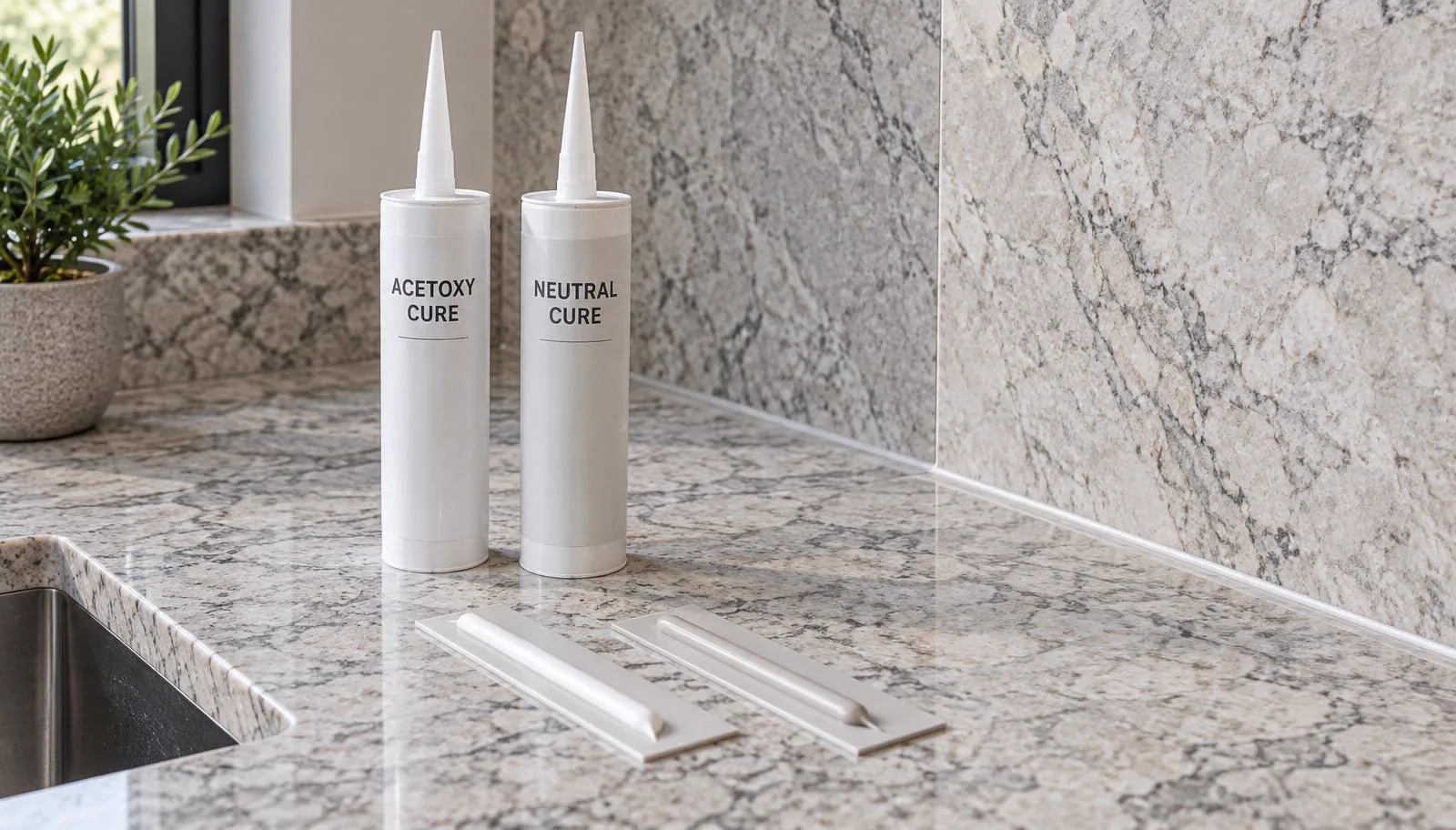
Two of the most common silicone curing systems are acetoxy cure and neutral cure.
Both can produce a flexible, waterproof seal. Both have legitimate applications. But they are not interchangeable.
When working around natural stone, choosing the correct silicone is particularly important because some silicones can cause staining, discolouration or chemical damage to sensitive surfaces.
For stone applications, the safest approach is to use a neutral-cure silicone specifically confirmed by the manufacturer as suitable for the particular stone and application.
What Is Acetoxy Cure Silicone?
Acetoxy silicone is also known as acid-cure silicone.
As it cures, it releases acetic acid. This is what produces the familiar strong vinegar-like smell associated with many traditional silicone sealants.
Acetoxy silicone has been used successfully for decades and is not an inherently bad product. It has some genuine advantages.
Advantages of acetoxy silicone
Fast curing
Acetoxy silicones can skin over relatively quickly, which can be useful where rapid installation and finishing are important.
Excellent adhesion to glass and ceramics
Acetoxy silicone has traditionally been very effective on materials such as glass and glazed ceramics.
Good water resistance
Once fully cured, a quality silicone provides a flexible and water-resistant seal.
Generally lower cost
Acetoxy products are often cheaper than specialist neutral-cure products.
Widely available
They are commonly stocked in hardware stores and trade suppliers, making them an easy product to reach for.
The Problem With Acetoxy Silicone Around Stone
The same chemistry that gives acetoxy silicone its characteristic smell also creates its biggest limitation.
During curing, it releases acetic acid. That acidic environment can be unsuitable for certain materials.
Natural stones such as marble, limestone and travertine are particularly sensitive to acids, and inappropriate sealants can cause etching or discolouration.
Even where a particular stone appears to tolerate acetoxy silicone, relying on the stone simply “looking fine” is not a professional specification.
The surrounding materials also need to be considered. Acetoxy silicones can be problematic around certain metals, coatings and other acid-sensitive materials.
This is especially important on a modern kitchen benchtop where silicone may sit against several different materials at once:
- Natural stone
- Engineered stone
- Ceramic or porcelain
- Glass
- Aluminium
- Stainless steel
- Painted surfaces
- Splashback materials
The silicone doesn’t know which material is the expensive one. It simply cures against everything it touches.
What Is Neutral Cure Silicone?
Neutral-cure silicone uses a different curing chemistry.
Instead of releasing acetic acid, neutral-cure systems use other curing mechanisms and produce different by-products. The result is a much less acidic curing environment.
This makes neutral-cure silicones suitable for a much wider range of construction materials.
Neutral cure is commonly specified where the sealant needs to be compatible with sensitive materials such as natural stone, metals, coatings and other substrates.
Advantages of Neutral Cure Silicone
1. Better compatibility with natural stone
This is one of the biggest reasons neutral cure is preferred around stone. It avoids the acidic curing chemistry associated with acetoxy silicone.
2. Lower risk of corrosion
Because neutral-cure silicone does not use an acetic-acid curing system, it is generally a better choice around sensitive metals such as aluminium, copper, brass and zinc.
This is particularly useful when a stone benchtop meets metal components or trims.
3. Better compatibility with a wider range of substrates
Neutral-cure silicones are commonly designed for use across a broader range of materials.
This is valuable for stone restoration and repair work because you often don’t have complete control over what materials are present around the joint.
4. Lower odour
Neutral-cure products generally have a much milder odour during curing than acetoxy silicone. This can be an advantage when working inside occupied homes.
The Disadvantages of Neutral Cure
It can cost more
A suitable neutral-cure silicone is often more expensive than a basic acetoxy product.
But the cost difference between cartridges is tiny compared with the cost of repairing or replacing a damaged stone surface.
Some products cure more slowly
Depending on the formulation and environmental conditions, neutral-cure products can take longer to skin and fully cure.
Temperature, humidity, bead size and the exact product all influence curing time.
Product selection matters
“Neutral cure” is not a magic label.
There are different neutral-cure chemistries and formulations, and they are designed for different applications. A professional should always follow the manufacturer’s technical data sheet and application recommendations.
Neutral vs Acetoxy — The Simple Comparison
| Feature | Acetoxy Cure | Neutral Cure |
|---|---|---|
| Curing chemistry | Acidic | Non-acidic |
| Characteristic smell | Strong vinegar smell | Much milder |
| Glass | Excellent | Excellent |
| Glazed ceramics | Excellent | Excellent |
| Natural stone | Generally unsuitable unless specifically approved | Preferred, but product must be stone-compatible |
| Sensitive metals | Can be problematic | Generally better suited |
| Coated surfaces | Product dependent | Generally broader compatibility |
| Cost | Usually lower | Usually higher |
| Initial cure | Often faster | Can be slower |
| Indoor use | Stronger odour | Generally more pleasant |
| Stone restoration | Avoid unless specifically approved | Preferred choice |
Why Neutral Cure Is Required Around Stone
This is where professional stone work differs from simply buying a tube of silicone.
When silicone is being applied directly against stone, the priority should not be: “Which silicone is cheapest?”
It should be: “Which silicone is chemically compatible with this stone and the other materials around it?”
Natural stone can be expensive, difficult to replace and impossible to restore perfectly once certain types of staining or chemical damage have occurred.
A cartridge of silicone is inexpensive compared with the potential cost of damaging a stone benchtop.
That is why neutral cure should be the default starting point for stone applications, followed by checking the exact product’s suitability for the particular stone.
An Important Point: Granite Is Not the Same as Marble
Not all natural stone behaves in exactly the same way.
Granite is generally much more resistant to acids than marble, limestone or travertine.
However, granite is not chemically identical from slab to slab. It can contain different minerals, have different porosity and have different finishes.
It can also be surrounded by other materials that may be sensitive to acetoxy silicone.
For this reason, choosing neutral cure isn’t simply about asking: “Will this granite etch?”
The better question is: “Is this sealant compatible with every material it will contact?”
That is the professional approach.
What About Engineered Stone?
Engineered stone also requires care.
Different engineered-stone products have different compositions and manufacturer requirements. Some contain high levels of quartz, while others use different mineral compositions or resin systems.
The fact that a surface looks similar to natural stone does not mean every silicone is automatically compatible with it.
Always check the manufacturer’s recommendations for the specific surface where possible.
How Can You Tell If Silicone Is Acetoxy?
One of the easiest clues is the smell.
If fresh silicone produces a strong vinegar-like smell, it is very likely an acetoxy or acid-cure product.
However, smell should not be your final method of product selection. Always check the cartridge, technical data sheet and manufacturer’s specifications.
Look for terms such as:
- Neutral Cure
- Non-Corrosive
- Suitable for Natural Stone
- Stone Compatible
Where natural stone staining is a concern, look for specific evidence that the product has been tested or approved for the relevant stone application.
When Is Acetoxy Silicone Still Useful?
Acetoxy silicone still has its place.
For suitable applications involving materials such as glass and glazed ceramics, acetoxy silicone can provide excellent adhesion and performance.
There is no need to say that acetoxy silicone is “bad.” The problem is using it where its chemistry isn’t appropriate.
Use the right silicone for the materials involved.
For stone restoration and stone benchtop work, that generally means selecting a suitable neutral-cure product rather than reaching for a generic acetoxy silicone.
The Stone Surface Solutions Rule
At Stone Surface Solutions, we believe silicone should be treated as part of the stone repair or restoration system — not simply as a finishing product.
When working around stone:
- Don’t choose silicone based on price.
- Don’t choose it simply because it says “Kitchen & Bathroom.”
- Don’t assume every neutral-cure silicone is stone-safe.
Instead:
- Identify the stone.
- Identify every material the silicone will contact.
- Check the manufacturer’s technical information.
- Select a suitable neutral-cure product.
- Follow the manufacturer’s application instructions.
- Where required, test compatibility before applying to the finished surface.
A professional silicone joint should protect the stone, not become the cause of another restoration problem.
Final Takeaway
Acetoxy and neutral-cure silicones both have legitimate uses.
Acetoxy silicone is fast, widely available, economical and excellent for many glass and ceramic applications.
Neutral cure costs more and can take longer to cure, but its non-acidic curing chemistry makes it a much safer starting point for applications involving sensitive materials.
For natural stone, neutral cure should be the default choice — but the exact product still needs to be confirmed as suitable for stone and resistant to staining.
When you’re working with an expensive stone benchtop, the few dollars saved by using the wrong silicone simply aren’t worth the risk.
The right silicone isn’t just about sealing the joint. It’s about protecting everything around it.